Strengths

240
Intake

842
Students Strengths

35
VTU Ranks

133
Placement offers 2024
105
Placement offers 2025
27.55 LPA
Highest pay package

Facilities
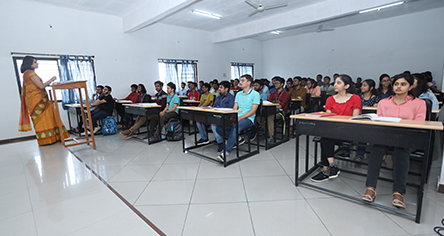
Class Rooms
Department of ECE has 9 Class Rooms each with seating capacity 70. Class room is equipped with blackboards and LCD projectors.
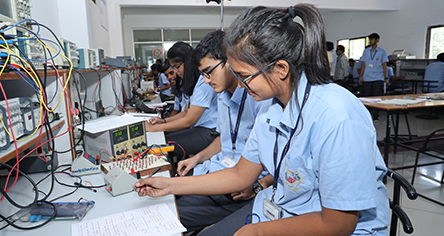
Laboratory
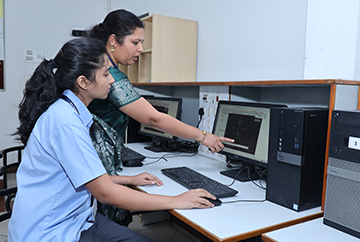
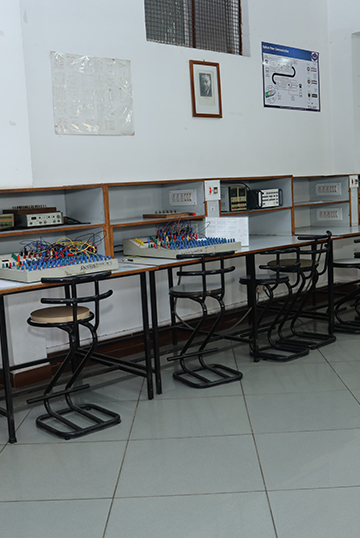
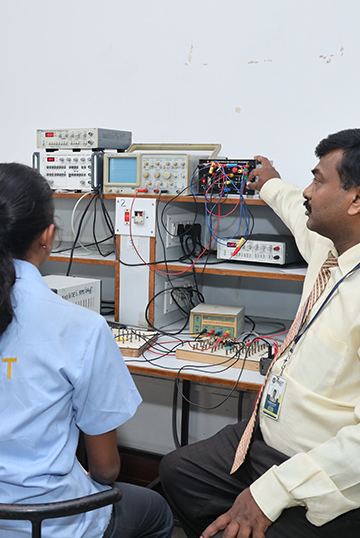
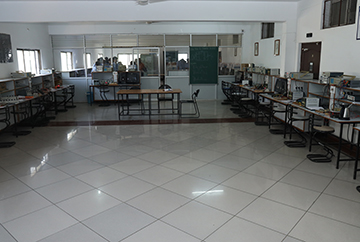
The Department of Electronics and Communication Engineering is equipped with nine well-established laboratories that support both academic learning and advanced research activities. These laboratories are furnished with modern instruments and experimental setups, including Cathode Ray Oscilloscopes (CRO), regulated power supplies, function generators, microwave integrated circuit kits, microwave benches, DPSK and QPSK communication kits, Optical Fiber Communication (OFC) kits, power electronics modules, FPGA kits, MCB 51 kits, 8086 microprocessor kits, Moku go kits and interfacing kits.
The department also houses computer systems, all enabled with high-speed internet connectivity, providing a robust computing environment for students and faculty.
In addition, the laboratories are equipped with licensed industry-standard software tools such as Cadence, LabVIEW, MATLAB, Keil, and Vivado, enabling students to gain hands-on experience aligned with current technological trends.
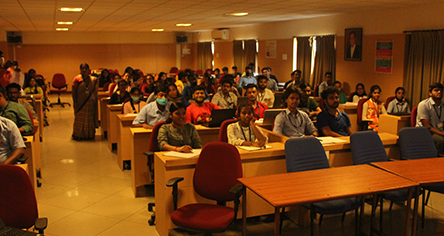
Seminar Halls
Department has 1 Seminar Hall with seating capacity of 100 with all the necessary facilities.
COE VLSI & ES
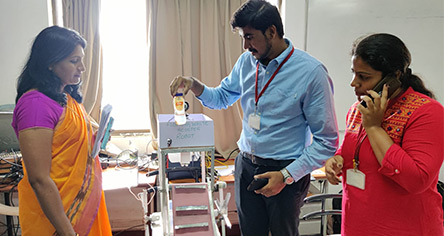
The Department of Electronics and Communication, RNS Institute of Technology established a Center of Excellence in VLSI in 2018, later upgraded to CoE–VLSI & Embedded Systems in September 2024. With MoUs involving TSMC, Tessolve Semiconductors, Maven Silicon, KPIT, and collaboration with Liquid Instruments, it supports research, projects, workshops, and industry interaction.
IOT Lab
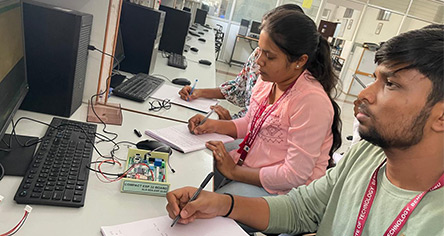
IoT (Internet of Things) lab in a college plays a crucial role in equipping students with practical knowledge and hands-on experience in a rapidly growing field. Students gain hands-on exposure to IoT technologies, sensors, devices, and communication protocols, which cannot be learned through textbooks alone. IoT labs help students develop important technical skills such as hardware interfacing, programming, networking, and data analysis, all of which are essential for future careers in tech.
Infrastructure