
About the Department
The Department of VLSI Design & Technology has been established to meet the growing demand for skilled professionals in semiconductor design and microelectronics. With an intake of 60 students, the department offers a comprehensive curriculum that blends theory with hands on training, preparing graduates for careers in the global semiconductor industry.
A specialized Curriculum covering Digital IC Design, HDL programming, Analog Design, Verification, and Physical Design is offered to the students. The Department is equipped with State of the art Laboratories equipped with FPGA kits, servers, and industry standard EDA tools. Experienced Faculty with expertise in ASIC, FPGA, and semiconductor design methodologies will assist the students in all their endeavours.
Learning here is not restricted to academic syllabus. We foster the research culture and encourage students to take on real time projects. The Department has Industry Collaboration with Nano-chips, TSMC's 3-way NDA, NIELIT for internships, projects, and placements assistances. A strong alumni connect ensures that students benefit from real world insights, career guidance, and professional opportunities, creating a vibrant ecosystem of learning and growth. The department places deliberate emphasis on critical thinking, effective teamwork, and the skill development to make our students industry ready.

Vision
To be a premier center of excellence in VLSI Technology and research, fostering an ecosystem that develops industry‑ready professionals.
Mission
- To provide quality education and hands on training in VLSI design and semiconductor technology, equipping students with the skills required to excel in industry and research.
- To foster innovation, critical thinking, and problem solving through advanced laboratories, industry collaborations, and interdisciplinary projects in microelectronics and chip design.
- 3. To contribute to national and global initiatives in semiconductor manufacturing by preparing graduates as competent professionals, ethical leaders, and lifelong learners in VLSI Technology.
- Chip Design & Verification Expertise Graduates will be able to design, model, and verify digital and analog integrated circuits using HDL languages, FPGA platforms, and industry standard EDA tools, ensuring functionality, performance, and reliability.
- Semiconductor Innovation & Application Graduates will apply VLSI design methodologies to develop efficient, low power, and scalable solutions for emerging technologies such as IoT devices, AI accelerators, and embedded systems, contributing to advancements in semiconductor research and industry.
Programme Outcomes define the knowledge, skills, and attitudes graduates are expected to possess at the time of graduation. PO 1–PO 11 align with NBA Graduate Attributes applicable to the CSBS programme.
- Engineering knowledge: Apply knowledge of mathematics, science, engineering fundamentals, and computing to solve complex engineering problems.
- Problem analysis: Identify, formulate, research literature, and analyse complex engineering problems using first principles of mathematics and engineering sciences.
- Design/development of solutions: Design solutions for complex engineering problems and systems that meet specified needs with appropriate consideration for public health, safety, cultural, societal, and environmental considerations.
- Investigations of Complex Problems: Use research-based knowledge and methods including design of experiments, analysis and interpretation of data to provide valid conclusions.
- Modern tool usage: Create, select, and apply appropriate techniques, resources, and modern engineering and IT tools to complex engineering activities with an understanding of their limitations.
- The engineer and society: Apply reasoning informed by contextual knowledge to assess societal, health, safety, legal, and cultural issues and the consequent responsibilities relevant to professional engineering practice.
- Environment and sustainability: Understand the impact of professional engineering solutions in societal and environmental contexts and demonstrate knowledge of and need for sustainable development.
- Ethics:Apply ethical principles and commit to professional ethics and responsibilities and norms of engineering practice.
- Individual and teamwork: Function effectively as an individual and as a member or leader in diverse teams and in multidisciplinary settings.
- Communication: Communication Communicate effectively on complex engineering activities with the engineering community and society at large; write effective reports, design documentation, and make effective presentations.
- Project management and finance: Demonstrate knowledge and understanding of engineering and management principles and apply these to manage projects in multidisciplinary environments.
- Professional Competence Graduates will establish themselves as competent engineers in the field of VLSI design and semiconductor technology, contributing effectively to industry, academia, and research organizations
- Innovation & Lifelong Learning Graduates will engage in continuous learning, adapt to emerging technologies, and demonstrate innovation in developing sustainable solutions for complex engineering problems in microelectronics and chip design.
- Leadership & Ethical Responsibility Graduates will assume leadership roles in multidisciplinary teams, uphold professional ethics, and contribute responsibly to societal and national initiatives in semiconductor manufacturing and technology development.
Graduates of this department will be well prepared for roles such as:
- Analog Design Engineer
- Verification Engineer
- Physical Design Engineer
- Researcher in Semiconductor Technology
Graduates of this program will be prepared for diverse roles in the semiconductor and Electronics Industry, including:
- Design Engineer – Developing digital and analog integrated circuits.
- Verification Engineer – ensuring correctness and reliability of chip designs.
- Physical Design Engineer – specializing in layout, timing, and optimization.
- EDA Tool Specialist – working with advanced design automation software.
- Semiconductor Researcher – contributing to innovations in microelectronics and nanotechnology.
- Embedded Systems Developer – integrating VLSI solutions into real world applications.
- Academia & Higher Studies – pursuing advanced degrees and research in microelectronics, VLSI, and semiconductor technology.
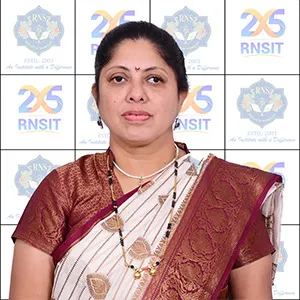
HOD's Message
Get In Touch
-
 principal@rnsit.ac.in
-
 080 28611880/
1/
2,+91 90359 60355
080 28611880/
1/
2,+91 90359 60355
-
 RNS Institute of Technology,
Dr. Vishnuvardhan Road
R R Nagar Post
Channasandra
Bengaluru -560 098


Send A Message